
Madhyamik 2027 Complete Suggestion Book & Question Bank: Prepare for WBBSE Class 10 Exam with 7 Subjects in One Place

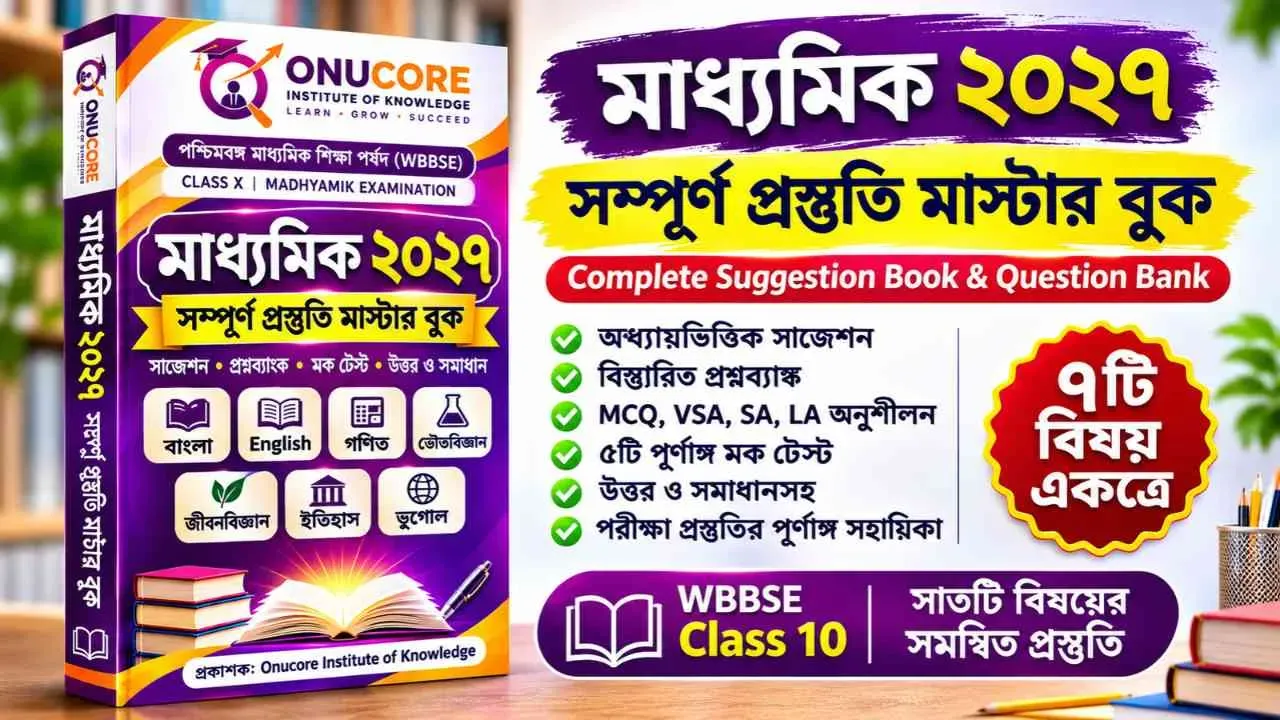
The West Bengal Madhyamik Examination is one of the most important academic milestones for students studying in Class 10. As the Madhyamik Examination 2027 approaches, students across West Bengal are looking for reliable study materials, chapter-wise suggestions, question banks, mock tests, and revision resources to strengthen their preparation.
Table of Contents25 sections
- Madhyamik 2027 Complete Suggestion Book & Question Bank | WBBSE Class 10
- Madhyamik 2027 Complete Suggestion Book: An Overview
- Madhyamik 2027 Complete Suggestion Book & Question Bank | WBBSE Class 10
- What Makes the Madhyamik 2027 Master Book Useful?
- 1. Complete Preparation for Seven Subjects
- Madhyamik 2027 Complete Suggestion Book & Question Bank | WBBSE Class 10
- 2. Subject-Wise Important Questions and Suggestions
- 3. MCQ, Short-Answer and Descriptive Question Practice
- 4. Mock Tests for Examination Preparation
- 5. English Grammar and Writing Practice
- 6. Mathematics: Improve Problem-Solving Skills
- 7. Physical Science: Concepts, Formulas and Numerical Problems
- 8. Life Science: Understand Concepts and Practise Diagrams
- 9. History: Develop Structured Answers
- 10. Geography: Maps, Diagrams and Conceptual Revision
- How Students Can Use the Master Book Effectively
- Step 1: Complete the Textbook First
- Step 2: Practise Chapter-Wise Questions
- Step 3: Prepare a Personal Revision Notebook
- Step 4: Attempt Mock Tests
- Step 5: Analyse Your Mistakes
- Suggested 30-Day Madhyamik 2027 Revision Plan
- Who Should Use This Book?
- Digital PDF: Read Online and Download
- Why Choose Onucore Institute of Knowledge?
Preparing for seven different subjects can be challenging. Students need to understand textbook concepts, practise different types of questions, improve their writing skills, solve mathematical problems, and revise important topics regularly.
To make this preparation more organised, Onucore Institute of Knowledge has introduced the Madhyamik 2027 Complete Suggestion Book & Question Bank, a comprehensive digital study resource designed for students appearing in the West Bengal Board of Secondary Education (WBBSE) Madhyamik Examination 2027.
The preparation collection brings together seven major subjects, including Bengali, English, Mathematics, Physical Science, Life Science, History and Geography. It combines subject-wise suggestions, question practice, mock tests and revision materials in one digital resource.
Students can read the material online through a secure viewer and download the PDF after purchasing it.
Madhyamik 2027 Complete Suggestion Book: An Overview
The Madhyamik 2027 Complete Preparation Master Book is designed to help Class 10 students organise their examination preparation without having to manage multiple disconnected study resources.
Instead of searching for separate question banks and practice materials for every subject, students can access a combined preparation collection covering all seven subjects.
Product Overview
| Particulars | Details |
|---|---|
| Product Name | Madhyamik 2027 Complete Suggestion Book & Question Bank |
| Examination | WBBSE Madhyamik Examination 2027 |
| Class | Class 10 |
| Board | West Bengal Board of Secondary Education |
| Total Subjects | 7 |
| Subjects | Bengali, English, Mathematics, Physical Science, Life Science, History and Geography |
| Academic Session | 2026–2027 |
| Language | Bengali and English |
| Product Format | Digital PDF |
| Access | Read Online + Download |
| Publisher | Onucore Institute of Knowledge |
| Official Website | https://theoik.com/ |
The collection is intended to support students through question practice, revision, and examination-oriented preparation.
What Makes the Madhyamik 2027 Master Book Useful?
A good examination preparation resource should do more than provide a list of important questions. Students need opportunities to practise different question formats, understand answers, identify weak areas, and improve their time management.
The Onucore Madhyamik 2027 Master Book brings several preparation resources together.
1. Complete Preparation for Seven Subjects
The biggest advantage of this collection is its coverage of seven subjects in one place.
Students can use the material to organise their preparation for:
- Bengali
- English
- Mathematics
- Physical Science
- Life Science
- History
- Geography
Each subject requires a different preparation strategy. Language subjects require reading, grammar and writing practice, while Mathematics and Physical Science require regular problem-solving. History and Geography require conceptual understanding, structured answers and revision.
Having the subjects together makes it easier to plan a balanced study schedule.
2. Subject-Wise Important Questions and Suggestions
The book includes subject-wise suggestions and important questions to help students focus their revision.
Students can use these questions to:
- Identify important topics for revision.
- Practise chapter-related questions.
- Improve answer-writing skills.
- Revise important concepts before examinations.
- Identify topics that require additional preparation.
Students should remember that suggestions are intended for practice and revision. No private publication can guarantee that a particular question will appear in the actual board examination.
3. MCQ, Short-Answer and Descriptive Question Practice
Different question formats require different answering techniques.
The collection includes practice opportunities involving:
Multiple Choice Questions (MCQ): These help students test their conceptual understanding and improve accuracy.
Very Short Answer Questions (VSA): Students can practise definitions, facts, names, terms and other concise answers.
Short Answer Questions (SA): These help develop the ability to explain concepts clearly and systematically.
Long Answer Questions (LA): Students can practise structured answers with appropriate explanations, relevant points and examples.
Regular practice across these formats can help students become more comfortable with written examinations.
4. Mock Tests for Examination Preparation
Mock tests are an important part of examination preparation.
Simply reading a chapter or memorising an answer is not enough. Students also need to practise answering questions within a limited period.
The mock test materials included in the collection can help students:
- Practise answering questions under examination conditions.
- Improve time management.
- Identify weak chapters.
- Understand which topics need further revision.
- Develop confidence in writing complete answers.
Students should attempt each available mock paper independently before checking the relevant answers or solutions.
5. English Grammar and Writing Practice
English preparation requires attention to reading comprehension, grammar, vocabulary and writing skills.
Students should regularly practise:
- Tense and sentence structure.
- Voice change.
- Narration change.
- Articles and prepositions.
- Joining and splitting sentences.
- Transformation of sentences.
- Paragraph writing.
- Notice writing.
- Report writing.
- Letter and other prescribed writing formats.
The English preparation materials are intended to support grammar and writing practice alongside regular textbook study.
6. Mathematics: Improve Problem-Solving Skills
Mathematics requires consistent practice. Students should understand the underlying formulas and methods rather than memorising solutions without understanding them.
The Mathematics preparation section supports practice in mathematical problem-solving and revision.
Students should focus on:
- Understanding mathematical concepts.
- Memorising and applying relevant formulas.
- Practising problems step by step.
- Checking calculations carefully.
- Managing time while solving questions.
- Revisiting difficult problems regularly.
A useful strategy is to maintain a separate notebook for formulas, important methods and frequently repeated mistakes.
7. Physical Science: Concepts, Formulas and Numerical Problems
Physical Science includes both theoretical concepts and numerical applications.
Students should give attention to understanding scientific principles, chemical reactions, equations, formulas and numerical problems.
For better preparation:
- Learn important scientific definitions.
- Practise chemical equations.
- Understand the laws and principles.
- Revise important formulas and SI units.
- Solve numerical problems regularly.
- Draw and label relevant diagrams wherever required.
The best approach is to combine conceptual learning with written practice.
8. Life Science: Understand Concepts and Practise Diagrams
Life Science preparation requires a clear understanding of biological processes and terminology.
Students should pay attention to:
- Important biological definitions.
- Life processes and their functions.
- Genetics and heredity.
- Evolution-related concepts.
- Environment and biodiversity.
- Biological diagrams and labelling.
- Differences between related biological terms.
Students should practise drawing diagrams neatly and labelling each part accurately.
9. History: Develop Structured Answers
History requires students to understand historical events, movements, personalities, causes and consequences.
Rather than memorising disconnected facts, students should develop a chronological understanding of important events.
For better preparation:
- Maintain a timeline of important events.
- Revise important personalities and their contributions.
- Understand the causes and consequences of historical movements.
- Practise short and descriptive answers.
- Use clear introductions and organised points.
Writing answers in a logical sequence can make historical explanations easier to understand.
10. Geography: Maps, Diagrams and Conceptual Revision
Geography preparation requires both theoretical knowledge and practical map-related skills.
Students should focus on:
- Physical geography concepts.
- Climate and natural processes.
- Indian geography.
- Resources and industries.
- Population and economic activities.
- Map identification and marking.
- Geographical diagrams and explanations.
Regular map practice is particularly useful because students need to become familiar with locations and their geographical significance.
How Students Can Use the Master Book Effectively
Having study materials is only the first step. Students need a consistent preparation strategy to get the best results.
Here is a suggested study approach.
Step 1: Complete the Textbook First
Students should study the prescribed textbooks and understand the basic concepts of each chapter.
The suggestion book should be used as a supporting resource, not as a replacement for textbooks.
Step 2: Practise Chapter-Wise Questions
After completing a chapter, solve the relevant questions from the question bank.
Start with MCQs and very short answers, then move towards short and descriptive questions.
Step 3: Prepare a Personal Revision Notebook
Maintain a separate notebook for:
- Important definitions.
- Mathematical formulas.
- Scientific equations.
- Historical dates.
- Geographical locations.
- English grammar rules.
- Frequently difficult questions.
This notebook can become a useful resource during the final revision period.
Step 4: Attempt Mock Tests
Set aside dedicated time for mock examinations.
Try to follow the prescribed examination duration and avoid looking at answers while solving a paper.
Step 5: Analyse Your Mistakes
After every mock test, identify:
- Questions answered incorrectly.
- Questions left incomplete.
- Chapters requiring additional revision.
- Problems taking too much time.
- Mistakes in spelling, calculations or presentation.
Improving these areas gradually can make preparation more effective.
Suggested 30-Day Madhyamik 2027 Revision Plan
Students who have already completed most of their syllabus can use the following suggested revision schedule.
| Period | Preparation Target |
|---|---|
| Days 1–7 | Revise important chapters across all seven subjects |
| Days 8–14 | Practise MCQs, short answers and descriptive questions |
| Days 15–18 | Focus on Mathematics and Physical Science problem-solving |
| Days 19–21 | Revise Life Science diagrams, History timelines and Geography maps |
| Days 22–25 | Attempt subject-wise mock tests |
| Days 26–28 | Identify weak areas and revise difficult topics |
| Days 29–30 | Final revision of formulas, definitions, maps and important answers |
This is a suggested revision plan. Students should adjust it according to their individual progress and school examination schedule.
Who Should Use This Book?
The Madhyamik 2027 Complete Suggestion Book & Question Bank may be useful for:
Class 10 Students: Students preparing for the WBBSE Madhyamik Examination 2027 who want organised practice materials for seven subjects.
Students Preparing for School Tests: Students who want additional questions and mock practice before school examinations.
Students in the Revision Stage: Students who have completed their textbooks and need structured question practice.
Students Who Prefer Digital Study Materials: Students who want to read study resources online or download PDF materials for revision.
Digital PDF: Read Online and Download
One of the convenient features of this product is its digital format.
After purchasing the product, students can:
- Read the document through a secure online viewer.
- Download the PDF file.
- Access the purchased study material digitally.
- Use the material for personal examination preparation.
The product page provides a Read Online + Download facility. It also states that lifetime access is available after purchase.
Students should check the product page for the latest access and purchase conditions.
Why Choose Onucore Institute of Knowledge?
Onucore Institute of Knowledge works in the education, skills and career development space.
Its educational resources are intended to support students through study materials, learning guidance and examination preparation resources.
The Madhyamik 2027 Complete Preparation Master Book follows this approach by bringing multiple subject-wise preparation resources into one collection.
Publisher: Onucore Institute of Knowledge
Website: https://theoik.com/